
Every Innovation Design engagement follows the same six stages. Not because creativity should be mechanical — but because the choices behind creativity should be visible, checkable, and repeatable. Here’s exactly what happens, in order.
What I Can Help You With
Stage 1 — Feature Map
We decompose your product into its real feature categories and sub-features — grounded in how the product actually works, not how we imagine it.
Checkpoint: You see the full map before we touch a single idea. If we’ve misread your product, we catch it here — not after weeks of ideation.
Stage 2 — Apply Structural Moves (SIT)
For every feature category, we generate concrete possibilities using five structural inventive principles — subtraction, multiplication, division, task unification, attribute dependency. This is the “what configuration solves this?” pass.
Checkpoint: Every category gets all five lenses. No shortcuts, no favourites.
Stage 3 — Apply Adaptive Moves (SAI)
For every feature category, we generate possibilities using the five Innovation Design principles — Contextual Adaptation, External Element Integration, Inversion, Minimalism, Clustering. This is the “how does it keep adjusting?” pass.
Checkpoint: Structural and adaptive ideas are generated with equal weight. One doesn’t crowd out the other.
Stage 4 — Possibility Tables
Every idea from Stage 2 and 3 goes into a structured table — grouped by feature, tagged by principle, traceable back to where it came from.
Checkpoint: Nothing is a loose sticky note. Every idea has a home and a rationale.
Stage 5 — Score
Every possibility gets rated on Practicality, Cost, and Impact — 1 to 5, each. Not gut feel. A structured judgment, made explicit.
Checkpoint: Scores are visible and defensible. If a domain expert disagrees, that disagreement gets captured — not buried.
Stage 6 — The 2×2 Matrix
We plot everything on an Impact-vs-Cost quadrant — bubble size for practicality, color for principle. What emerges is a ranked, visual roadmap, not a backlog of good intentions.
Checkpoint: You leave with a prioritized list you can actually act on — and a clear record of why each item ranked where it did.
Repeatable by Design
The six stages arent a one-way pipeline. You can return to any stage, change an input, and run forward
again — without starting from zero.
Change the feature map (Stage 1)
New market insight, new constraint — and Stages 2–6 regenerate around it.
Swap which principles you emphasize (Stages 2–3)
Maybe this round you want a pure SAI pass to stress-test adaptability, without re-running SIT.
Adjust scoring weights (Stage 5)
Say Cost suddenly matters more than Impact this quarter — and the 2×2 matrix re-ranks instantly.
Why it matters: Markets shift, budgets shift, ans so to leadership’s priorities. A process that breaks every time an input changes isn’t rigour — it’s fragility wearing a process costume. Ours holds up because every stage is a function of the one before it, not a one-time workshop output. Change the input, re-run the stages that depend on it, and you get a new answer — not a new project.
Why This Beats a typical Stage-Gate approach
Traditional stage-gate innovation processes are built on a hidden assumption: that you’ll get it right the first time through. When a project gets killed at Gate 3, the work from Gates 1–3 is usually sunk. Reviving it later often means starting the whole sequence over — because the
process wasn’t built to resume, only to proceed.
Innovation Design doesn’t have that failure mode. Because every stage is a function of the one before it — not a standalone workshop output — going back and changing an input only re-runs what depends on it. Nothing upstream is wasted.
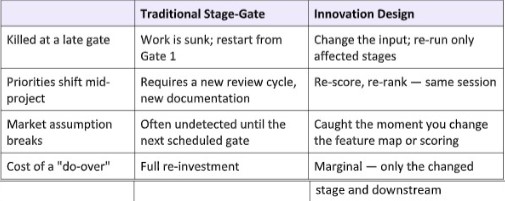
The result:
Fewer abandoned projects, faster course-correction, and money spent on refining a direction instead of re-discovering one you already paid for once.
This is the difference between innovation and Innovation Design. Anyone can generate ideas. Few can show you, stage by stage, exactly how each one was found, why it survived, and what it’s worth.